We have created a google group (i.e. an online discussion forum) called "CTZEN Development" for the discussion of Chung Tai Zen Center possible initiatives and developments for the future, topics such as protecting our environment, outreaching, how to better serve the public with the Dharma and the Buddhist way of life.
Everyone can see the group discussions here: http://groups.google.com/group/ctzen-dev
However, I encourage you to "join this group" (on the left panel of the webpage), so that you can be an active participant and post messages to the group. To do so I believe you need a google account; you can use your regular email to set up the google account. If you have gmail then use that as your email, though gmail is not necessary (it is slightly more convenient with gmail if you use other google services like google calendar).
Then, please post to to group with your suggestions to what the Zen Center can do, or information and links regarding the environment, global warming, vegetarianism, etc. I see this forum as one for both discussion of ideas and also a depository of information. You may post from the website, or send an email to ctzen-dev@googlegroups.com. Remember this will go to everyone in the group.
Anyone who is a participant of Zen Center of Sunnyvale or Buddha Jewel Monastery classes may join.
You may also set up the way you receive messages from the group: receive each message as an email, as a digest (aggregate of emails once a day or so), or never--that means you need to use the website to see the messages and information.
There are some older posts on this group because it was originally set up for the development discussions of Buddha Jewel Monastery in Seattle. You may read them or ignore them. This group is now expanded to discuss issues relevant to both Sunnyvale and Buddha Jewel.
Thursday, June 11, 2009


Tuesday, June 9, 2009
Ten Commandments and Eightfold Path for Inter-religious Dialogue
Shifu attended an South Bay Interfaith meeting today, and in part of the meeting we discussed the "Ten Commandments for Inter-religious Dialogue". It was quite interesting. Here they are:
First Commandment: The primary purpose of dialogue is to change and grow in the perception and understanding of reality and then to act accordingly.
Second Commandment: Interreligious dialogue must be a two-sided project—within each religious community and between religious communities.
Third Commandment: Each participant must come to the dialogue with complete honesty and sincerity.
Fourth Commandment: Each participant must assume a similar complete honesty and sincerity in the other partners.
Fifth Commandment: Each participant must define him/herself. Conversely—the one interpreted must be able to recognize him/herself in the interpretation.
Sixth Commandment: Each participant must come to the dialogue with no hard-and-fast assumptions as to where the points of disagreement are.
Seventh Commandment: Dialogue can take place only between equals, or par cum pari.
Eighth Commandment: Dialogue can take place only on the basis of mutual trust.
Ninth Commandment: Persons entering into interreligious dialogue must be at least minimally self-critical of both themselves and their own religious traditions.
Tenth Commandment: Each participant eventually must attempt to experience the partner’s religion “from within.”
This is called "Dialogue Decalogue" written by Professor Leonard Swidler. This is a good beginning. Now can you come up with a "Four Noble Truths" or "Eightfold Path" of inter-religious dialogue and, more importantly, cooperation? That is, after fruitful dialogues, how do we apply the ideas of Eightfold Path to bring different religions together to work on projects of common human interest?
First Commandment: The primary purpose of dialogue is to change and grow in the perception and understanding of reality and then to act accordingly.
Second Commandment: Interreligious dialogue must be a two-sided project—within each religious community and between religious communities.
Third Commandment: Each participant must come to the dialogue with complete honesty and sincerity.
Fourth Commandment: Each participant must assume a similar complete honesty and sincerity in the other partners.
Fifth Commandment: Each participant must define him/herself. Conversely—the one interpreted must be able to recognize him/herself in the interpretation.
Sixth Commandment: Each participant must come to the dialogue with no hard-and-fast assumptions as to where the points of disagreement are.
Seventh Commandment: Dialogue can take place only between equals, or par cum pari.
Eighth Commandment: Dialogue can take place only on the basis of mutual trust.
Ninth Commandment: Persons entering into interreligious dialogue must be at least minimally self-critical of both themselves and their own religious traditions.
Tenth Commandment: Each participant eventually must attempt to experience the partner’s religion “from within.”
This is called "Dialogue Decalogue" written by Professor Leonard Swidler. This is a good beginning. Now can you come up with a "Four Noble Truths" or "Eightfold Path" of inter-religious dialogue and, more importantly, cooperation? That is, after fruitful dialogues, how do we apply the ideas of Eightfold Path to bring different religions together to work on projects of common human interest?
Monday, June 1, 2009
Morality in animals and stress reduction
How are these two topics related?
By Buddhism, of course!
In the sutras Buddha have told stories of all animals can help or even sacrifice themselves for others. Sounds incredible? Well, more and more evidence shows that animals are indeed capable of doing that. A monkey and a rat would rather starve themselves than obtaining food at the cost of hurting another of their kind. Chimpanzees have drowned themselves trying to save others. Dolphins gathered to carry shipwrecked humans to safety. These are real stories reported by scientists that seem obvious to Buddhists but incredible to those who believe that only humans have intelligence and ethical behavior. Here are a couple of links: New York Times article, a book by a U. of Colorado professor Marc Bekoff, "Wild Justice".
On another thread, CNN just reported on a West Virginia University study that identified the benefits of mindfulness practice on reducing stress.
By Buddhism, of course!
In the sutras Buddha have told stories of all animals can help or even sacrifice themselves for others. Sounds incredible? Well, more and more evidence shows that animals are indeed capable of doing that. A monkey and a rat would rather starve themselves than obtaining food at the cost of hurting another of their kind. Chimpanzees have drowned themselves trying to save others. Dolphins gathered to carry shipwrecked humans to safety. These are real stories reported by scientists that seem obvious to Buddhists but incredible to those who believe that only humans have intelligence and ethical behavior. Here are a couple of links: New York Times article, a book by a U. of Colorado professor Marc Bekoff, "Wild Justice".
On another thread, CNN just reported on a West Virginia University study that identified the benefits of mindfulness practice on reducing stress.
they found those who received the mindfulness training "had significantly less daily hassles, psychological distress and significantly fewer medical symptoms" -- like lower blood pressure and fewer aches and pains -- than those who were handed a pamphlet.
Waugh says she was thrilled to find that after practicing mindfulness techniques, the back pain that had plagued her for almost a decade went away. She also said she "communicated better with fellow employees and actually had a better attitude towards my job." ...
Mindfulness is not new. It goes back to the time of Buddha, who believed that the mind should always be fully in the present -- not looking back at the past or anticipating the future. Being mindful of the here-and-now, Buddha said, reduces stress and brings inner peace ...
According to the study, even 10 minutes of meditation can help. "[Meditation] can take the anxiety out of a stressful workday," said Williams.
West Virginia University is not the first -- or only -- institution in the country that has tested the effects of mindfulness techniques on stress. UCLA completed a study a few years ago that found the same thing the WVU study found: Mindfulness exercises are excellent stress-busters ... Yale University is recruiting patients for a smoking cessation study that includes a mindfulness training component.
Sunday, May 31, 2009
十宗綱要-淨土宗1
2009-05-26 & 27
淨土宗第一講:
淨土宗第一講:
- 何謂淨土
- 觀無量壽經故事(韋提悉夫人)
廬山慧遠大師故事
- 頻婆娑羅王敬奉佛陀,為何會有阿闍世這樣的逆子?
- 淨土祖師:曇鸞、善導、永明延壽、省常、蓮池、蕅益、省庵大師的生平要略。
Saturday, May 30, 2009
十宗綱要-律宗5: 見月讀體律師
見月律師
慧雲律師之後由寂光三昧律師繼承衣缽,而寂光是見月律師之師。寂光、見月二位開創了寶華山的律宗祖庭,延續數百年一直到今日。見月律師天縱英才,但一生坎坷,在他自述的「一夢漫言」可見到一代祖師求法、弘法、護法的艱辛歷程。
http://ccbs.ntu.edu.tw/FULLTEXT/JR-BJ012/bj104419.htm
見月是繼明末三昧律師之後,住持寶華山,大弘千華律的一代宗匠,
讀體字見月,姓許氏,雲南楚雄(縣)人。舊籍江南句容(
由於父母早逝,伯父又無子,很欣賞見月之聰慧秀朗,
出家後的見月,頗受亮如法師倚重。然見月為求受大戒,
從三昧律師受戒後,見月鑑於天下戒法淪喪,綱紀蕩然,
距金陵七十里外的寶華山隆昌寺,為梁朝寶誌和尚的道場,
弘光元年(1645),三昧和尚自知時至,傳衣缽給見月,
像寶華山這種以弘戒為主的律宗叢林,在〈十約〉
比起稍早的古心律祖和三昧律師,見月所處的時代更是混亂。
然而,禍不單行,不久便有人密告於清軍統帥巴大將軍,
在清初惡劣的環境中,見月更表現出修道人的節操,
慈善行為本來就是佛教的基本德目之一,面對當時的人間苦難,
比起古心和三昧,見月在律學上造詣,更為博大精深,
見月之著述,計有十六種:《毗尼止持會集》十六卷、《
在見月多年的精心整頓之下,
順治10年(1653)8月上旬,
經過兩次般舟苦行,寺眾對於見月難行難忍之能耐,
昔年律學久荒涼,波旬蕩檢稱法王。賴吾祖父整巨綱,金錫再振聲琅琅。
南山日月輝大唐,群生苦海獲浮囊。 泰山頹後痛滄桑,木叉搖搖孰主張?
吾師乘願振影堂,鐵鑄頭顱石作腸。千拗不折此脊樑,精金萬煉成金剛。
千華大席踞繩床,講磨五部澄冰霜。毗尼精持汰嘝糠,羯磨久廢重舉揚。
聲流薄海偏梯航,北動幽都南越裳。 繭足萬里趨門牆,磨濯身心稟戒香。
鎚金琢玉罏塎強,烹龍束象建高幢。屏除魔外勢攙搶,毒辣門風比桂薑。
年登六十面雖蒼,般舟苦行骨昂藏。佛法江河瀾正狂,得師砥柱正中央。
層樓複閣繞壇場,煌煌堂構響隆昌。 海涵地負冠遐荒,雞足鵝頭萬載光。
願師壽量同古皇,永為法海作堤防。
康熙17年(1678)除夕,見月微恙。康熙18年(1679)
十宗綱要-律宗4: 慧雲馨公律師
慧雲如馨律師
律宗自宋元照律師以降,數代後又沒落,乃至明朝以幾乎不傳。後得文殊菩薩感應,一切律法印現於心,中國律宗始得延續不絕。自慧雲律師之後,連續數代高僧輩出,在這朝政混亂、社會不安的時代,艱辛的再建律宗大法幢。
http://www.hkbuddhist.org/magazine/508/508_09.html
今日所有漢僧傳戒道場,祖堂中都要供奉「慧雲馨公律師」的牌位,
通過對三藏的探究,古祖深感要振興佛教,必須從律學入手,「
萬曆十二年(1584),古祖回到南京住古林庵。其時,庵「
萬曆四十一年(1613),皇帝頒詔,
不久,古祖奉旨還山,回到南京古林寺。乃以皇帝所賜法衣,
十宗綱要-律宗3: 元照律師
元照律師-簡介
律宗自南山道宣律師大興律學,之後遭到唐武宗毀佛的大肆破壞,到了北宋時已是不復往昔。元照律師在宋朝振興律宗,讓學佛再度重視戒律,並注釋南山三大部。
元照律師,字湛然,俗姓唐,浙江餘杭人,
元照律師-詳細介紹
元豐八年(一○八五年)十二月,高麗僧統義天(?∼一一○一年)
其後,元照鑒於當時禪僧輕視戒律和念佛,乃於紹聖三年(一○
紹聖五年(一○九八年)二月,元照於明州(今浙江寧波)開元寺,
元照的思想,主張戒律和淨土並重。他常對門徒說︰「生弘律範,
元照力說比丘受持淨戒的必要。他說︰「出家之人,若禪若教,
元照以二種教觀,判別釋迦一代佛教,
元照又唱律、禪、教三學一源之說。他說︰「律,佛所制也﹔教,
元照倡導律、淨二學相結合,並著書、造像、講學、傳戒,
律宗傳至宋代,以南山道宣一系為盛。但南山律宗祖承,
元照的著述,在律學方面有解釋南山三大部的「
元照的及門弟子見於史傳的有用欽、戒度、行詵、慧亨、道言、
用欽,從元照學律,並專修淨業。著有「白蓮記」四卷釋元照「
戒度,號拙庵,居四明龍山。學「四分律」,晚年專修淨業,撰「
行詵、慧亨、道言、宗利、思敏也都修習念佛法門。
智交的事跡不祥。他的門下出惟一,惟一門下出法政,
十宗綱要-律宗2: 南山宗開山祖師-道宣律師
南山道宣律師
http://www.lingguangsi.com/show.aspx?id=1748&cid=14
“外博九流,內精三學,戒香芬潔,定水澄漪,存護法城,
農歷十月初三日恭逢唐代終南山道宣律師紀念日。道宣律師精研《
生平
道宣是中國佛教律宗三派之一南山宗的創立者。
道宣律師(596—667),俗姓錢,字法遍。浙江吳興縣人(
自武德七年(624)長住終南山,與孫思邈結林下之交。
大師的著作涵蓋有:贊、集、觀、儀、傳、錄、疏、鈔八大類。
即:《住法圖贊》等二部贊﹔《廣弘明集》等三種集﹔《淨心誡觀》
《感通傳》、《續高僧傳》等三部傳﹔《大唐內典錄》、《
道宣律師隱居於終南山仿掌谷,精研諸律,著有《
十宗綱要-律宗1
我們已上完了十宗綱要之中「律宗」的介紹。
這裏是一些律宗祖師相關的資料:
屬於佛教經錄類﹔它提供了考証佛教譯傳源流之依據,也為後來佛教大藏經之編修有了軌跡可尋。本書在文獻資料的收集整理上貢獻至鉅,無論在中國佛教學術史、目錄文獻學、思想文化史等多方面來說,佔有特殊的地位與價值。
這裏是一些律宗祖師相關的資料:
中國律學大師資料 -- 僧佑、道宣、元照、慧雲馨、見月
僧佑律師
http://www.fjzd.org/news/ShowArticle.asp?ArticleID=1733
僧佑(445-518),俗姓俞,祖籍彭城下邳(江蘇徐州邳縣)
十四歲時,父母悄悄為他籌辦婚事,他得知後,為避婚事,
1、弘揚律學,傳授戒法。師晚年自述謂:「少受律學,刻意毘尼,
2、勤奮著述,編撰《法集》。師在弘揚律學、傳授戒法之餘,
3、監造佛像,莊嚴精美。在《法苑集》一書中,
由於師戒德莊嚴,博學多才,在齊梁兩代,備受朝野崇敬,
1、「名錄」部份對漢至梁譯撰的一切經論(由於當時南北阻隔,
2、「經序」部份是了解漢至梁時代經論譯傳的背景、經過、時間、
3、「列傳」部份是現存最早的僧傳,它繼承中國史書「列傳」
Thursday, May 28, 2009
Sugar in soft drinks
This is a really cool idea: let us visualize the amount of sugar in the soft drinks, compared with everything we eat.
Here is the website.


Here is the website.
Saturday, May 23, 2009
中國評論新聞報導惟覺老和尚
「中國評論新聞」社高層專訪中台禪寺,老和尚親自陪同介紹。
五月二十二日、二十三日,連續二天 老和尚登上「中國評論新聞」首頁:
惟覺大和尚:兩岸是兄弟 勿結冤仇

惟覺大和尚:我要送溫總理一件寶物

China Review News did an in-depth interview on Chung Tai, making it the headline news for two days in a row, introducing Chung Tai Chan Monastery to the greater general Chinese population.
五月二十二日、二十三日,連續二天 老和尚登上「中國評論新聞」首頁:
惟覺大和尚:兩岸是兄弟 勿結冤仇
惟覺大和尚:我要送溫總理一件寶物
China Review News did an in-depth interview on Chung Tai, making it the headline news for two days in a row, introducing Chung Tai Chan Monastery to the greater general Chinese population.
Monday, May 18, 2009
Monday, May 11, 2009
鳳凰衛視 惟覺老和尚及中台禪寺專訪
鳳凰衛視北京製作的「智慧東方」節目介紹 導師惟覺老和尚及中台禪寺:
(This is the first of a two-part special on Chung Tai Chan Monastery and the Grand Master Wei Chueh, made by Phoenix Chinese TV for broadcast in China)
(This is the first of a two-part special on Chung Tai Chan Monastery and the Grand Master Wei Chueh, made by Phoenix Chinese TV for broadcast in China)
Friday, May 8, 2009
Buddha Birthday coming up!

Don't forget the Buddha Birthday Ceremony this Sunday!
Chinese service starts at 9am
Bilingual service starts at 11am
We'll have a special performance of Indian Dance that tells the story of "Diamond Chou" and his encounter with Master Dragon Lake, a classic Zen koan. Don't miss this one of a kind dance!
別忘了周日是今年度的佛誕浴佛大法會。我們將會有一個特別的印度舞蹈,講述「周金剛」遇到龍潭禪師而開悟的故事,不可錯過!
Saturday, May 2, 2009
Rocky Mountains, Colorado
Jianhu Shifu got to spend a few days in the Rocky Mountains in solitude. A wonderful experience.


You can view a gallery of these pictures here.
萬物靜觀皆自得,大塊假我以文章
Calmly observe
And the myriad phenomena become self-evident.
Nature narrates itself
Perfectly.
山中無甲子,人間幾千年
Living in the mountains
there is no sense of time
meanwhile, in the mundane world
a thousand years have passed.


You can view a gallery of these pictures here.
Monday, April 27, 2009
Inneswoods, Columbus, Ohio
Jianhu Shifu gave some lectures in Columbus, Ohio from 4/13 ~ 4/15. At Columbus we visited a beautiful garden, Inneswoods, which was donated by the Innes sisters, and very well maintained by the City.


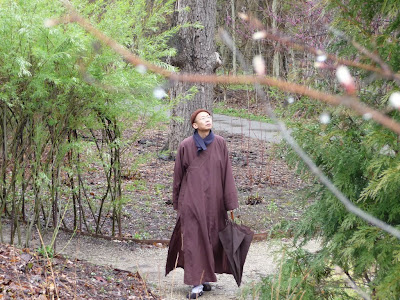


心法雙忘猶隔妄 色空不二尚餘塵
百鳥不來春又過 不知誰是住庵人
--性空禪師


Forgetting both the mind and phenomena, still veiled in delusion;
Realizing the non-duality of form and emptiness, the dust remains.
The birds do not visit, spring has gone again,
Who is the person abiding in this hut?
-- Zen Master Xing Kung
心法雙忘猶隔妄 色空不二尚餘塵
百鳥不來春又過 不知誰是住庵人
--性空禪師
Saturday, April 11, 2009
Cherry and Plum Blossoms in Seattle
(Updated with a new poem!)
Here are some pictures of the first cherry blossoms at University of Washington last week.
華盛頓大學的櫻花初開。


Also, some plum trees we'll be getting for Buddha Jewel.
佛寶寺將來要種的梅花樹。


歸來偶把梅花嗅 春在枝頭已十分
And a response from Bessie from East Bay with a beautiful translation of a Zen poem by Master poet-monk Cold Mountain:

今日畏人攀 明朝待誰掃
可憐嬌豔情 年多轉成老
將世比於花 紅顏豈長保
Here are some pictures of the first cherry blossoms at University of Washington last week.
華盛頓大學的櫻花初開。


Also, some plum trees we'll be getting for Buddha Jewel.
佛寶寺將來要種的梅花樹。


Straw sandals treading cloud covered peaks終日尋春不見春 芒鞋踏破隴頭雲
I sought spring everywhere.
Returning in vain, I stopped
To smell the plum blossom
On the treetops is spring in full glory.
--An enlightenment poem by a bhiksuni
歸來偶把梅花嗅 春在枝頭已十分
And a response from Bessie from East Bay with a beautiful translation of a Zen poem by Master poet-monk Cold Mountain:

Behold the flower amid the leaves君看葉裡花 能得幾時好
How long can her glory last?
Fearing to be picked today,
Who’ll sweep her away tomorrow?
Pity, loveliness so fragile,
Aging quickly with time.
This life is like the flower’s
Can beauty long endure?
--by Cold Mountain
今日畏人攀 明朝待誰掃
可憐嬌豔情 年多轉成老
將世比於花 紅顏豈長保
--寒山詩
Tuesday, April 7, 2009
十宗綱要-成實宗02: 介紹及十號品
2009-03-31 & 04-01
這堂課我們講成實要義,課文的內容:二諦、二空、三心,將會由在此摘錄的《成實論--滅三心品》文中解釋。
這次講到前三段,從「論者:滅三種心名為滅諦」至「以世諦故愚者不諍」。
這二諦:真諦(第一義諦)、世諦(俗諦)並存,皆為宇宙人生之真理,是很重要的觀念,希望大家認想一想。了達這二諦,世間所有的爭論就不必要了。
下次我們會繼續研討講義。
這堂課我們講成實要義,課文的內容:二諦、二空、三心,將會由在此摘錄的《成實論--滅三心品》文中解釋。
這次講到前三段,從「論者:滅三種心名為滅諦」至「以世諦故愚者不諍」。
這二諦:真諦(第一義諦)、世諦(俗諦)並存,皆為宇宙人生之真理,是很重要的觀念,希望大家認想一想。了達這二諦,世間所有的爭論就不必要了。
下次我們會繼續研討講義。
Monday, April 6, 2009
Buddha Jewel in featured in Seattle Newspaper
Buddha Jewel Monastery was featured in the local newspaper. We thank Mr. Mike Millon of the South Seattle Beacon for this interview and a nice report, as well as giving the permission to reprint it here and in our websites.
Buddha Jewel Monastery: A new neighbor on the block
By Mike Dillon
For years the church near the intersection of South Kenyon Street and Rainier Avenue South had been a source of neighborhood concern: in-house financial improprieties, loudspeaker evangelicalism and a deteriorating building.
How things have changed.
Buddha Jewel Monastery, 7930 Rainier Ave. S., opened at the site last September. All it took was an outreach effort from the well-established Chung Tai Monastery in Taiwan and an abbot with a doctorate in computer science who renounced the blandishments of the world in order to explore the meaning of life.
The abbot is the Venerable Jian Hu, 45. Hu lives on the premises with three other brown-robed monks and has reached out to the community with free classes on Zen meditation (see sidebar).
Hu came to the United States as a teenager and graduated from high school in Las Vegas. He went on to earn a degree from the California Institute of Technology and completed his doctorate at the University of California, San Diego. A well-paid job in the aerospace industry followed.
"It was a good job," Hu recalled, "but I felt something was lacking. In college I asked myself questions: What is the meaning of life?"
As an undergrad, his reading delved into philosophy and religion. "When I dug into Zen Buddhism, it made sense to me - not only as a belief but as a practice. When your perspective changes, your world changes."
Hu, soft-spoken, focused, formally polite and quick to laugh, returned to Taiwan to study with the noted Chinese Zen master Wei Chueh.
Zen discipline, which includes meditation, is focused on seeing into the nature of reality or, as the Zen saying goes, not mistaking the finger pointing to the moon for the moon itself.
The practice traces its roots to China, where it flourished around 700 A.D. In this country Zen surfaced in mainstream American culture after World War II. One of its Western pioneers, British citizen Reginald Blyth, traveled to pre-war Japan to study Zen and found himself interned during the war. After the war he tutored the Crown Prince.
His ground-breaking, quirky, five-volume "Zen and Zen Classics" caught the attention of American students of Zen, like author Allen Watts, Catholic monk Thomas Merton and literary vagabond Jack Kerouac.
Blyth wrote: "What is Zen? Zen means doing anything perfectly - making mistakes perfectly, hesitating perfectly, having stomachache perfectly. 'Perfectly' means that the activity is harmonious in all its parts."
Blyth's words are a perfectly Western permutation, of course. Asian Zen Buddhist practitioners look to their ancient, sacred scriptures and logic-twisting koans to put them on the road to enlightenment.
As Hu noted, enlightenment does not mean "a serene daze, but a clear, quiet mind that allows for kindness and compassion" - qualities that perhaps take on more urgency in the current economic climate.
"Being fully aware of the present," Hu observed, "you can see opportunities. You can explore behind the suffering and fear."
Hu said the home monastery in Taiwan financially supported the creation of its Seattle chapter, but he expects his monastery to be financially self-sustaining.
The monastery and grounds occupy 1.5 acres. Inside, the ambience is one of simplicity with ornate touches. The meditation hall - the main space with a large altar where a statue of Buddha presides - is the site for services and meditation classes.
An upstairs library houses Chinese texts and artwork. In the basement there's a dining hall and - the modern world breaking in on timeless simplicity - a computer room. Hu smiles at the irony, but then irony has a home in Zen practice.
Out in front two lion statues face Rainier Avenue South. Hu said lions figure in Buddhist belief: People are apt to listen to their roar as they would the truth.
A rock garden is under construction, and there are plans under way for a Chinese garden that would be open to the public.
Frank Kliewer, 62, attends services at the monastery. He is also an artist and former Christian preacher who is a consultant on the landscape work.
"People of all faiths come by and are pleased by the building and what's going on," he said. "It brings a totally different spirit to the neighborhood."
Buddha Jewel Monastery: A new neighbor on the block
By Mike Dillon
 |
| ■ An old church with a troubled past is now Buddha Jewel Monastery, a Zen Buddhist religious community that is reaching out to the community. photo courtesy of Buddha Jewel Monastery |
 |
| ■ The Venerable Jian Hu left a high-paying job in the aerospace industry to pursue the meaning of life. photo courtesy of Buddha Jewel Monastery |
For years the church near the intersection of South Kenyon Street and Rainier Avenue South had been a source of neighborhood concern: in-house financial improprieties, loudspeaker evangelicalism and a deteriorating building.
How things have changed.
Buddha Jewel Monastery, 7930 Rainier Ave. S., opened at the site last September. All it took was an outreach effort from the well-established Chung Tai Monastery in Taiwan and an abbot with a doctorate in computer science who renounced the blandishments of the world in order to explore the meaning of life.
The abbot is the Venerable Jian Hu, 45. Hu lives on the premises with three other brown-robed monks and has reached out to the community with free classes on Zen meditation (see sidebar).
Hu came to the United States as a teenager and graduated from high school in Las Vegas. He went on to earn a degree from the California Institute of Technology and completed his doctorate at the University of California, San Diego. A well-paid job in the aerospace industry followed.
"It was a good job," Hu recalled, "but I felt something was lacking. In college I asked myself questions: What is the meaning of life?"
As an undergrad, his reading delved into philosophy and religion. "When I dug into Zen Buddhism, it made sense to me - not only as a belief but as a practice. When your perspective changes, your world changes."
Hu, soft-spoken, focused, formally polite and quick to laugh, returned to Taiwan to study with the noted Chinese Zen master Wei Chueh.
Zen discipline, which includes meditation, is focused on seeing into the nature of reality or, as the Zen saying goes, not mistaking the finger pointing to the moon for the moon itself.
The practice traces its roots to China, where it flourished around 700 A.D. In this country Zen surfaced in mainstream American culture after World War II. One of its Western pioneers, British citizen Reginald Blyth, traveled to pre-war Japan to study Zen and found himself interned during the war. After the war he tutored the Crown Prince.
His ground-breaking, quirky, five-volume "Zen and Zen Classics" caught the attention of American students of Zen, like author Allen Watts, Catholic monk Thomas Merton and literary vagabond Jack Kerouac.
Blyth wrote: "What is Zen? Zen means doing anything perfectly - making mistakes perfectly, hesitating perfectly, having stomachache perfectly. 'Perfectly' means that the activity is harmonious in all its parts."
Blyth's words are a perfectly Western permutation, of course. Asian Zen Buddhist practitioners look to their ancient, sacred scriptures and logic-twisting koans to put them on the road to enlightenment.
As Hu noted, enlightenment does not mean "a serene daze, but a clear, quiet mind that allows for kindness and compassion" - qualities that perhaps take on more urgency in the current economic climate.
"Being fully aware of the present," Hu observed, "you can see opportunities. You can explore behind the suffering and fear."
Hu said the home monastery in Taiwan financially supported the creation of its Seattle chapter, but he expects his monastery to be financially self-sustaining.
The monastery and grounds occupy 1.5 acres. Inside, the ambience is one of simplicity with ornate touches. The meditation hall - the main space with a large altar where a statue of Buddha presides - is the site for services and meditation classes.
An upstairs library houses Chinese texts and artwork. In the basement there's a dining hall and - the modern world breaking in on timeless simplicity - a computer room. Hu smiles at the irony, but then irony has a home in Zen practice.
Out in front two lion statues face Rainier Avenue South. Hu said lions figure in Buddhist belief: People are apt to listen to their roar as they would the truth.
A rock garden is under construction, and there are plans under way for a Chinese garden that would be open to the public.
Frank Kliewer, 62, attends services at the monastery. He is also an artist and former Christian preacher who is a consultant on the landscape work.
"People of all faiths come by and are pleased by the building and what's going on," he said. "It brings a totally different spirit to the neighborhood."
Friday, April 3, 2009
DharmoRock
As the Chinese say, "rare is precious", here in Seattle, one can get excited and all cheerful just by seeing sunshine. In California nobody gives a second thought about it. Perhaps it is the same with the Dharma? When it is too accessible, it's easy to forget how precious it is.
Here are a couple of pictures of the DharmoRock we got in front of Buddha Jewel. Doesn't it look like a natural Bodhidharma statue? And it arrived at the local rock center just as a month ago. Must be sent by Bodhisattva Sangharama, the Dharma Guardian of temples.
「物以稀為貴」,在西雅圖,單是見到陽光就能讓人心情開朗無比。而在加州,都不以為意。佛法也是如此嗎?太容易得到了就忘了法之珍貴。
這是佛寶寺前的「達磨石」,不正像渾然天成的達磨祖師嗎?正好在上個月前到達西雅圖的石材中心,肯定是護法伽藍送來的。


Neither give rise to aversion when seeing evil,
Nor be overzealous when seeing good;
Neither forsake wisdom to be ignorant,
Nor reject delusion to pursue enlightenment.
Realizing the Great Way exceeds all limits,
Entering the Buddha Mind is liberation.
Linger with neither the mundane nor the divine,
Transcending all, one is known as a "Patriarch."
亦不睹惡而生嫌,亦不觀善而勤措。
亦不捨智而近愚,亦不拋迷而就悟。
達大道兮過量,通佛心兮出度。
不與凡聖同躔,超然名之曰祖。
Here are a couple of pictures of the DharmoRock we got in front of Buddha Jewel. Doesn't it look like a natural Bodhidharma statue? And it arrived at the local rock center just as a month ago. Must be sent by Bodhisattva Sangharama, the Dharma Guardian of temples.
「物以稀為貴」,在西雅圖,單是見到陽光就能讓人心情開朗無比。而在加州,都不以為意。佛法也是如此嗎?太容易得到了就忘了法之珍貴。
這是佛寶寺前的「達磨石」,不正像渾然天成的達磨祖師嗎?正好在上個月前到達西雅圖的石材中心,肯定是護法伽藍送來的。


Neither give rise to aversion when seeing evil,
Nor be overzealous when seeing good;
Neither forsake wisdom to be ignorant,
Nor reject delusion to pursue enlightenment.
Realizing the Great Way exceeds all limits,
Entering the Buddha Mind is liberation.
Linger with neither the mundane nor the divine,
Transcending all, one is known as a "Patriarch."
亦不睹惡而生嫌,亦不觀善而勤措。
亦不捨智而近愚,亦不拋迷而就悟。
達大道兮過量,通佛心兮出度。
不與凡聖同躔,超然名之曰祖。
Subscribe to:
Posts (Atom)


 Posts
Posts


